Behind the scenes with local artist Ron Gurgol
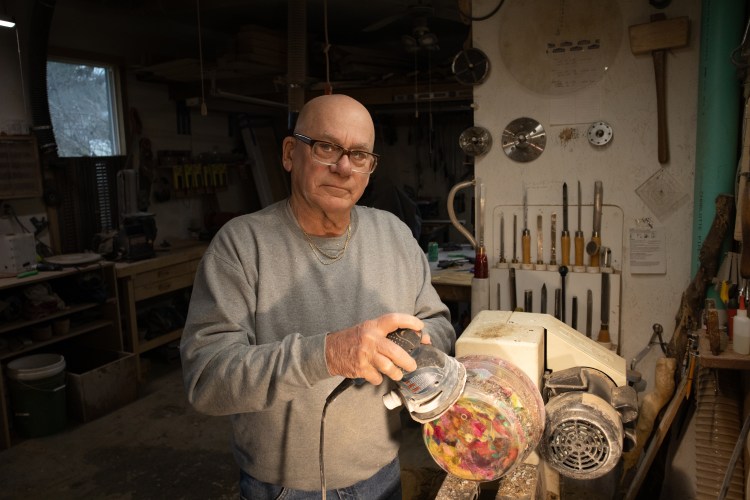
The wood lathe was once a highlight of Ron Gurgol’s high school shop class – a tool he thoroughly enjoyed before life took him in a different direction. For 50 years, he did not touch a lathe, building a life as a remodeling contractor instead. But as retirement approached, he knew he wanted to purchase a lathe of his own and return to the woodshop. He was ready to rediscover the scent of wood shavings and the magic of woodturning.
“Art was not a part of my childhood. I was a kid who enjoyed fixing things, taking them apart and putting them back together – radios, toasters, old furniture.”
– Artist Ron Gurgol
“Art was not a part of my childhood,” Gurgol said. “I was a kid who enjoyed fixing things, taking them apart and putting them back together – radios, toasters, old furniture.”
Gurgol’s journey from fixer to creator began outside Buffalo, New York, where he worked for his father’s roofing and siding company, starting at age 13. His father ensured he was well-rounded, apprenticing him alongside electricians and other tradesmen – building a foundation that instilled a lifelong respect for how things are built.
In 1978, Gurgol moved to Salem, Indiana, to co-found Gurgol/Webster Construction. He spent the following decades as a pillar of the local building community, even spending 10 years teaching the next generation at Prosser Career Education Center in New Albany. Before retiring in 2022, he served the region as a home inspector, a role that required the same keen eye for detail he now applies to his art.
Though Gurgol is entirely self-taught as a wood turner, he credits his partner, Wende Cudmore – a fashion designer and fellow artist – with helping him to bridge the gap between contractor and creator.
When Gurgol purchased a used 1947 lathe in 2018 as a prelude to retirement, he did not just stumble into a hobby, he reclaimed a piece of his old “fixer” identity. When that first machine broke down shortly after he bought it, his decades of mechanical experience paid off – true to his nature, he simply fixed it himself and kept turning.
“As a remodeling contractor, I did not often focus on the charm of an old porch; I saw the support beams and the settled foundations. Driving around town, my eyes would instinctively jump to a failing valley on a roof or the way a ridge sagged after 80 years of snow.I was always looking for where the structure was under stress.”
– Artist Ron Gurgol
“As a remodeling contractor, I did not often focus on the charm of an old porch; I saw the support beams and the settled foundations,” Gurgol explained. “Driving around town, my eyes would instinctively jump to a failing valley on a roof or the way a ridge sagged after 80 years of snow. I was always looking for where the structure was under stress.”
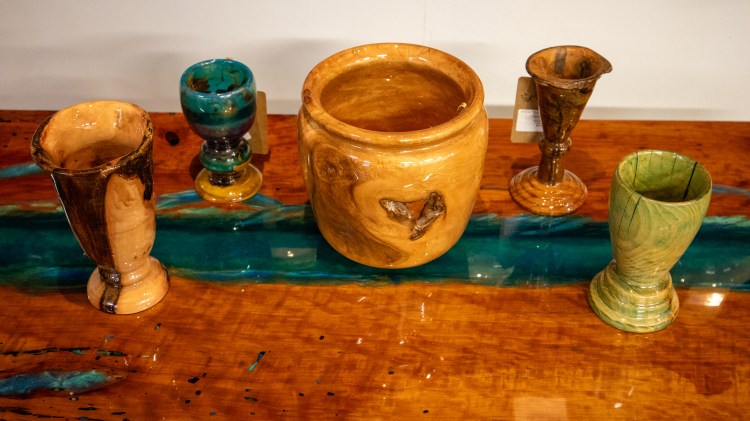
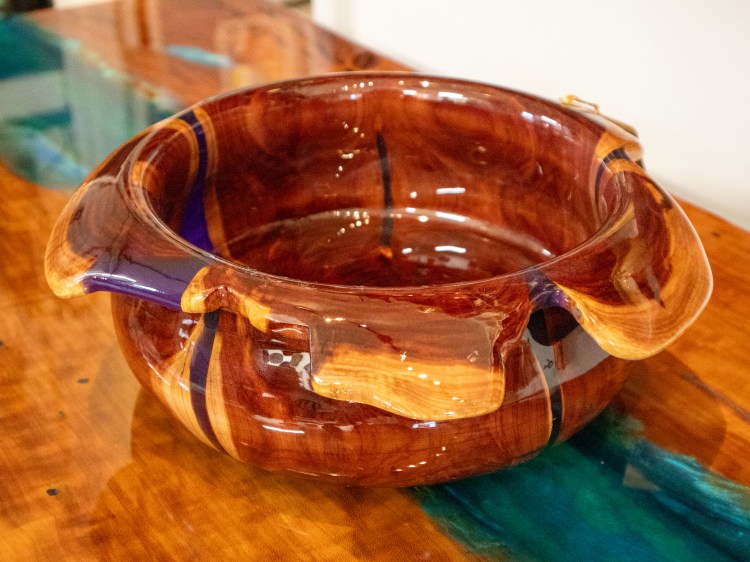
Today, that same eye for detail helps him find the art hidden inside the tension of the grain. One of Gurgol’s most intriguing pieces is a cedar bowl that showcases this structural intuition. Unlike trees that maintain a consistent diameter, cedar trunks taper quickly as they rise, making the fiber more irregular than more uniform trees.
“Cedar is my favorite wood to work with,” Gurgol said. “The irregular shape makes it full of possibility, and, of course, the scent is amazing.”
Cedar trees also produce many branches, which result in a high concentration of knots. While many wood turners will often cut these knobs off to achieve a smooth surface, Gurgol saw an opportunity to experiment with the wood’s natural architecture.
Cedar trees also produce many branches, which result in a high concentration of knots. While many wood turners will often cut these knobs off to achieve a smooth surface, Gurgol saw an opportunity to experiment with the wood’s natural architecture.
“I wondered how it would look to leave these knobs as part of the bowl, then cut under them to allow them to fold over the rim.”
The result is stunning. The folded-over rim showcases the organic structure of the wood. Characterized by a rustic style, the bowl features live edges, natural nodes and crannies enhanced by the folding technique.
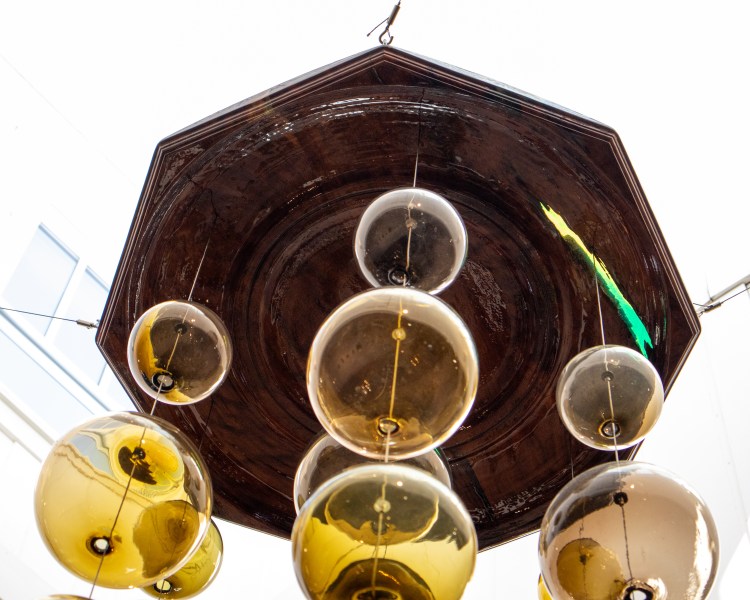
While the cedar bowl demonstrates Gurgol’s fascination with raw nature, his larger scale works showcase his ability to marry wood with other local legacies. Hanging in the cupola of Harrison County Arts Gallery in Corydon is perhaps his most ambitious project to date: a massive chandelier canopy commissioned specifically to hold hand blown Zimmerman glass globes. It is a striking centerpiece that bridges two distinct crafts, anchoring the gallery with a sense of local pride. For Gurgol, it is the piece that brings him the most satisfaction – a permanent fixture in the heart of historic Corydon.
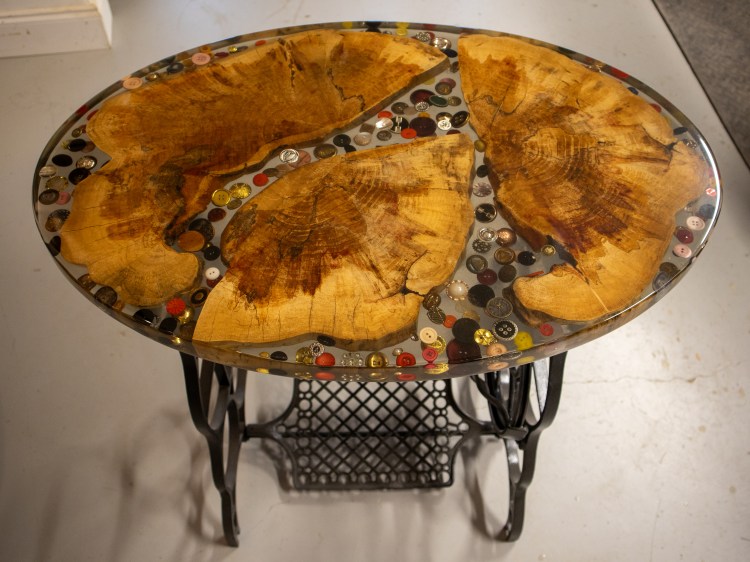
In contrast to the grand scale of the gallery commission is a piece that feels much more intimate. Titled “Mother’s Button Table,” this work was born from a call for upcycled art from a local gallery, and a bit of “alleyway” inspiration. Gurgol rescued an old-fashioned iron sewing machine base from a neighbor’s trash, seeing a second life for the metal as the table’s foundation.
In contrast to the grand scale of the gallery commission is a piece that feels much more intimate. Titled “Mother’s Button Table,” this work was born from a call for upcycled art from a local gallery, and a bit of “alleyway” inspiration. Gurgol rescued an old-fashioned iron sewing machine base from a neighbor’s trash, seeing a second life for the metal as the table’s foundation.
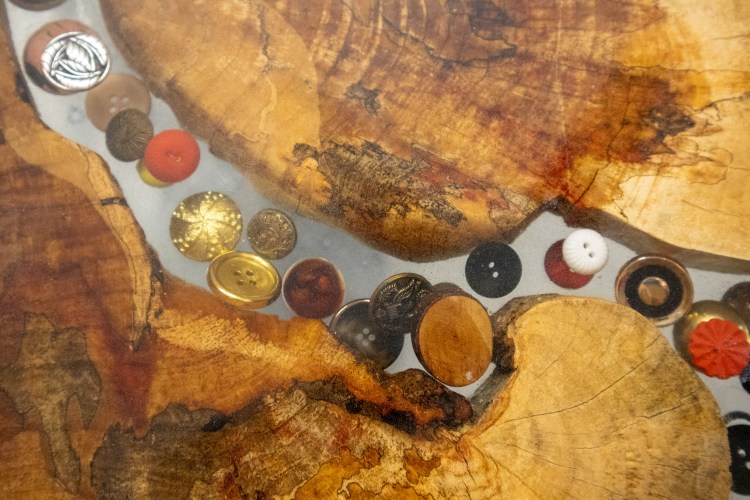
For the tabletop, he arranged chunks of box-elder, a wood known for its surprising streaks of color, and filled the voids with a treasure trove of old buttons his late mother had saved for repairs. Suspended in clear epoxy and polished to a mirror finish, the buttons create a vibrant mosaic-like surface. It is a piece that is as much a time capsule as it is furniture. One can easily imagine it tucked into a sunlit sewing room, a colorful tribute to the practical mending hands of a previous generation.
Today, retirement for Gurgol is less a rest and more a continuation of a life spent working with his hands. His property in Salem is a woodturner’s paradise, stacked with a scavenger’s bounty of logs and salvaged timber – more, he admits, than he can ever use.
“I really hope schools don’t give up on the shop programs. That very first class I took – it’s the reason I have all this today.”
– Artist Ron Gurgol
Standing at his new lathe in his garage turned studio, Gurgol didn’t mince words about the future: “I really hope schools don’t give up on the shop programs,” he said, looking at the curls of wood at his feet. “That very first class I took – it’s the reason I have all this today.”
Gurgol and Cudmore also maintain a small private gallery on site to showcase their work. Open to the public by appointment, the gallery offers a glimpse into a late-blooming partnership rooted in a shared creative spirit. •
For more information on Gurgol, you can visit his and Cudmore’s Facebook page at R&W Wood-N-Veggies.
Story by Judy Cato
Photos by Lorraine Hughes
.